What We Know, What We Don’t, and Why EPA Delayed Nationwide Monitoring
Last reviewed: July 2026. EPA’s UCMR 6 and CCL 6 actions are procedural and may change as rules and lists are finalized.
Microplastics have been detected in drinking water, bottled water, food, air, dust, and human tissues. That does not mean every detection is known to be harmful, nor does it mean drinking water is the dominant exposure route. It does mean that microplastics have moved from a marine-pollution topic into a public-health and drinking-water question.
The scientific picture is still developing. Researchers can increasingly detect smaller particles, including nanoplastics, but measurement has advanced faster than health-risk interpretation. EPA’s recent actions reflect that tension: microplastics are now on EPA’s draft Sixth Contaminant Candidate List, but they were not included in the proposed Sixth Unregulated Contaminant Monitoring Rule for nationwide drinking-water monitoring. EPA’s stated reason was methodological: the agency said there was no validated EPA or consensus drinking-water analytical method ready for UCMR 6 within the statutory timeframe (U.S. Environmental Protection Agency [EPA], 2026a, 2026b).
15-second takeaway Microplastics are present in drinking water and deserve serious study. But the field still lacks fully standardized monitoring methods, dose metrics, and health-risk benchmarks. EPA has elevated microplastics as a drinking-water priority, but has not yet required nationwide monitoring or set a federal drinking-water limit.
Evidence status
| Evidence question | Current status |
| Are microplastics present in tap water and bottled water? | Yes. Studies and reviews have reported microplastics in both, though results vary widely by method and particle-size range. |
| Are humans exposed to microplastics? | Yes. Exposure can occur through water, food, air, dust, packaging, textiles, and other sources. |
| Have microplastics been reported in human tissues or biological samples? | Yes. Reports now include several tissues and sample types, but detection does not by itself prove harm. |
| Does drinking water contribute to total exposure? | Probably, but the relative contribution of drinking water compared with food, air, dust, and packaging remains uncertain. |
| Do current drinking-water exposures cause specific diseases? | Not yet established. Laboratory, animal, and human observational studies raise plausible concerns, but causal drinking-water risk is not yet quantified. |
| Is there a federal drinking-water limit for microplastics? | No. EPA has not set a national maximum contaminant level or treatment technique for microplastics in drinking water. |
1. Why microplastics in drinking water matter
Microplastics are no longer only a remote ocean-pollution issue. They are now part of the broader question of how modern materials move through air, soil, food, water, and the human body. EPA researchers define microplastics, or MPs, as plastic particles ranging from 5 millimeters down to 1 nanometer, a range that includes larger visible fragments as well as much smaller particles that require specialized instruments to detect. EPA also distinguishes between primary microplastics, which are manufactured at small sizes, and secondary microplastics, which form when larger plastic materials break down (EPA, 2026c).
Drinking water is important in discussions of microplastics because it is a daily, population-wide exposure route. Even a low level of contamination can become important if exposure is chronic, widespread, and difficult for consumers to avoid. At the same time, the presence of microplastics in water does not by itself establish the degree of health risk. Risk factors may include particle size, number, shape, polymer type, chemical additives, attached contaminants, dose, route of exposure, and how the body handles different kinds of particles.
The World Health Organization’s 2019 technical review concluded that reports of microplastics in treated tap water and bottled water raised legitimate public-health questions, but also emphasized that major evidence gaps remained. WHO called for better data on occurrence, treatment removal, exposure, toxicology, and monitoring methods rather than treating the existing evidence as a settled basis for simple health claims (World Health Organization [WHO], 2019).
That distinction is central to this topic. ‘Microplastics are present’ is a different claim from ‘microplastics in drinking water are causing disease at current exposure levels.’ The first claim is increasingly well supported. The second remains more difficult to answer because the science has not yet converged on standardized measurement methods, dose metrics, or health-risk thresholds suitable for nationwide drinking-water regulation.
For consumers, the practical message is therefore nuanced: concern is reasonable, indifference is premature, and panic is not justified by the current drinking-water evidence. Microplastics deserve serious monitoring and research, but the field still has to solve basic measurement and interpretation problems before national data can be meaningfully compared across utilities, regions, water sources, and treatment systems.
2. What counts as a microplastic?
The word microplastic sounds simple, but it is not used consistently across all scientific papers, agencies, and monitoring programs. In general, microplastics are small plastic particles or fragments. The most common upper size boundary is 5 millimeters, roughly the size of a pencil eraser. Particles larger than that are usually treated as larger plastic debris rather than microplastics. EPA currently uses a broad research definition that includes plastic particles from 5 millimeters down to 1 nanometer, while other frameworks separate the smallest particles into a related category called nanoplastics (EPA, 2026c).
That lower boundary matters. A particle that is 4 millimeters wide, a fiber that is 100 micrometers long, and a particle measured in nanometers may all be called microplastic in some contexts, but they are not equivalent from the standpoint of measurement, treatment removal, or possible biological behavior. Larger particles may be captured more readily by conventional filtration. Smaller particles may require more sensitive instruments to detect and may behave differently in the body. For drinking-water monitoring, therefore, it is not enough to ask whether microplastics are present. A useful result should also say what size range was measured, what kinds of particles were counted, and what analytical method was used.
Researchers also distinguish primary and secondary microplastics. Primary microplastics are manufactured at small sizes, such as plastic pellets or intentionally produced microscopic particles. Secondary microplastics form when larger plastic items break down through abrasion, sunlight, heat, weathering, and ordinary use. Fibers shed from synthetic textiles, fragments from packaging, particles from tire wear, and debris from plastic infrastructure can all contribute to the broader environmental load.
Another complication is that plastic is not one substance. Microplastics may include polyethylene, polypropylene, polyethylene terephthalate, polystyrene, polyvinyl chloride, nylon, and other polymers. They may occur as fragments, fibers, films, foams, beads, or irregular particles. They may also contain chemical additives or accumulate other substances on their surfaces. For health and treatment questions, these differences may matter. A fiber is not necessarily comparable to a sphere, and a weathered particle is not necessarily comparable to a newly manufactured particle of the same polymer.
This definitional problem is one reason microplastics have been difficult to fold into routine drinking-water regulation. Drinking-water monitoring programs need standardized methods: what size range to sample, how to avoid contamination during sampling, how to identify polymer type, how to report particle counts, and how to compare results across laboratories. The need for standardized sampling and analytical methods is a recurring conclusion in recent reviews of microplastics in drinking water (Yang et al., 2024).
For H2O IQ purposes, this article uses microplastics as a broad term for small plastic particles and fragments, while noting when evidence is specifically about larger microplastics, smaller microplastics, or nanoplastics. That distinction is not pedantic. It affects how contamination is measured, how results are interpreted, and whether one study can reasonably be compared with another.
3. How microplastics get into drinking water
Microplastics can enter drinking-water systems at several points. Some are already present in rivers, lakes, reservoirs, or groundwater before water reaches a treatment plant. Others may be introduced or altered during treatment, distribution, storage, bottling, or household use. The relative importance of each pathway depends on the water source, surrounding land use, stormwater controls, wastewater discharges, treatment technology, distribution system, and sampling method.
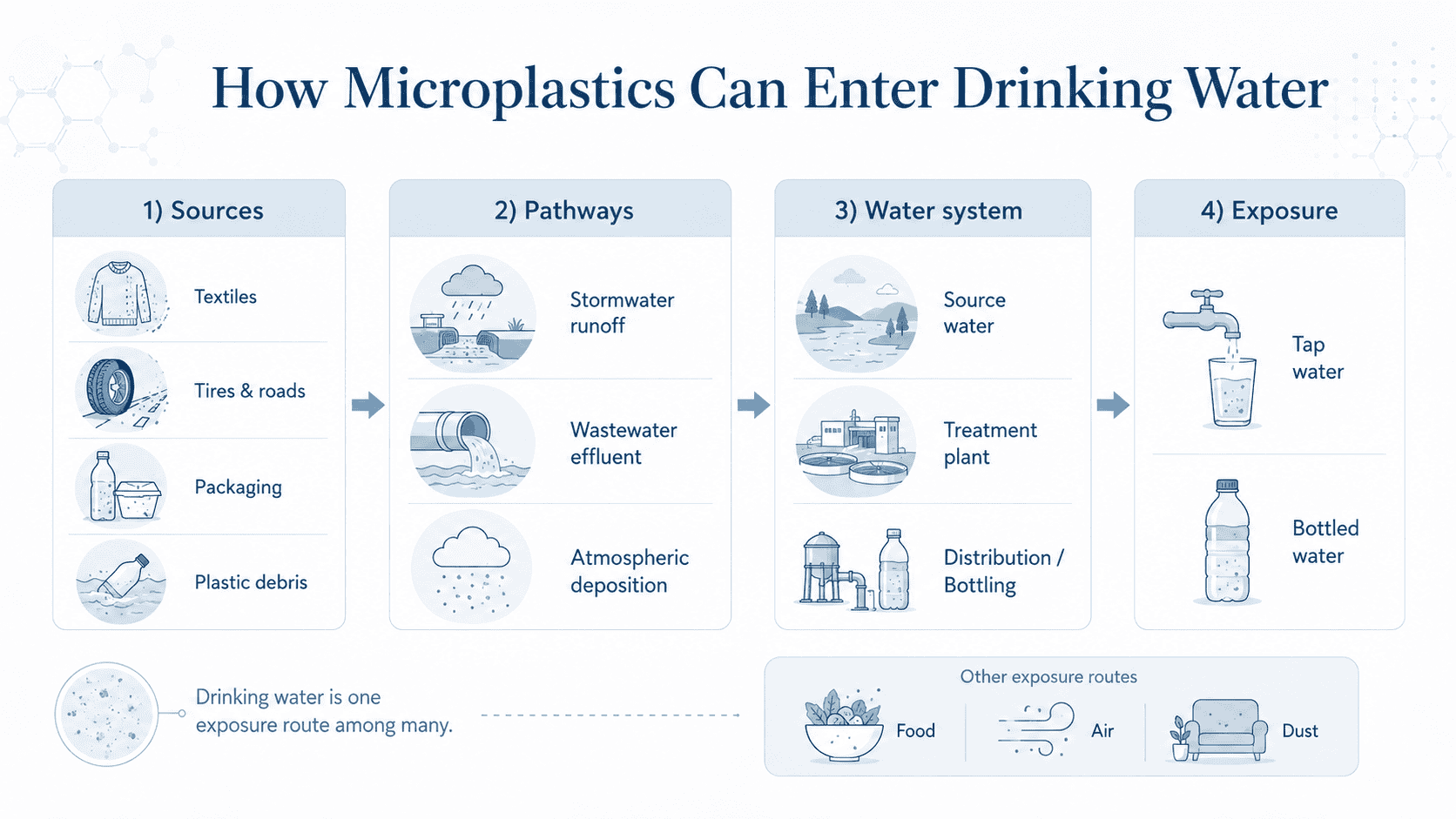
For surface-water systems, likely pathways include stormwater runoff, treated wastewater effluent, atmospheric deposition, litter breakdown, tire and road-wear particles, synthetic textile fibers, and plastic debris from urban or agricultural land use. EPA’s description of secondary microplastics includes particles that form as larger plastic materials break down, while WHO’s drinking-water report examined microplastics in the broader water cycle, including drinking-water sources, treatment, and wastewater pathways (EPA, 2026c; WHO, 2019).
Stormwater is a particular concern because it can wash particles from roads, sidewalks, rooftops, industrial areas, construction sites, and urban litter into streams and reservoirs. Wastewater is another pathway, but it should be described carefully. Wastewater treatment plants can remove many microplastic particles, especially larger ones, yet removal is not necessarily complete. Treated effluent may still carry smaller particles, fibers, or fragments into rivers and coastal waters. Wastewater treatment can also concentrate particles into sludge, which may become relevant if biosolids are applied to land and particles later move through runoff, erosion, or other pathways.
Atmospheric deposition adds another route. Microplastic fibers and fragments have been detected in air, including in remote environments. This does not mean the atmosphere is the dominant drinking-water source everywhere, but it helps explain why microplastics can appear even in places not obviously adjacent to plastic waste.
Drinking-water treatment may reduce microplastic concentrations, but removal depends on particle size, shape, density, surface characteristics, and the specific treatment train. Conventional treatment steps such as coagulation, sedimentation, filtration, and disinfection were not designed around microplastics as a regulatory target, yet some of those processes may remove a fraction of particles incidentally. Advanced filtration technologies may remove smaller particles more effectively, but performance varies by method and by the particle sizes actually measured.
Distribution systems and consumer products can also complicate interpretation. Water may pass through plastic pipes, linings, fittings, storage tanks, filters, tubing, or household devices before it is consumed. Bottled water introduces additional variables, including bottle material, caps, filling processes, storage conditions, and sample handling. A measured particle in finished drinking water may therefore reflect source-water contamination, incomplete treatment removal, distribution-system contributions, packaging, laboratory contamination, or some combination of these.
The most scientifically responsible conclusion is that there is no single microplastics pathway into drinking water. Microplastics move through a network of environmental, infrastructural, and consumer pathways. That complexity does not make the issue unimportant; it means that good monitoring must be specific about where samples were collected, what particle sizes were counted, what polymers were identified, and what potential contamination controls were used.
4. What studies have found in tap water and bottled water
Studies have reported microplastics in both tap water and bottled water. That basic finding is now difficult to dismiss. The harder question is how much plastic is present, what kinds of particles are being counted, and whether results from different studies can be compared directly.
Early public attention focused heavily on bottled water. One widely cited 2018 study tested bottled water from multiple countries and reported synthetic polymer particles in most samples, with an average concentration in the hundreds of particles per liter. That study helped trigger broader public and regulatory attention, but it also reflected the analytical limits of the time: many early studies were better at detecting larger microplastics than very small microplastics or nanoplastics.
More recent work suggests that the smallest particles may substantially change reported counts. A 2024 PNAS study estimated micro- and nanoplastic concentrations in bottled water at about 2.4 x 10^5 particles per liter, with nanoplastics accounting for about 90% of the total (Qian et al., 2024). That does not mean earlier studies were necessarily wrong; it means they were often measuring a different size range. When smaller particles are included, particle counts can rise sharply.
Tap-water studies also report microplastics, but with wide variation. WHO concluded that microplastics had been reported in treated tap water and bottled drinking water, but emphasized that available data were limited by inconsistent methods, different particle-size cutoffs, contamination concerns, and uneven study quality. WHO did not treat the occurrence evidence as meaningless; rather, it treated the evidence as insufficient for confident health-risk conclusions or routine global monitoring recommendations at that time (WHO, 2019).
Recent reviews have found that microplastics appear to be widespread in drinking water, while still stressing the same methodological problem. A 2024 systematic review described large variation in reported drinking-water concentrations and called for standardized sampling and analysis (Yang et al., 2024). A 2022 narrative review likewise reported microplastics in tap and bottled water and noted that reported concentrations may increase as smaller particle sizes are included (Gambino et al., 2022).
Bottled water often appears to contain more plastic particles than tap water in comparative studies, especially when smaller particles are measured. However, this should not be turned into an oversimplified rule that bottled water is always worse or tap water is always safe. Bottled-water results can be affected by packaging, caps, bottling processes, storage conditions, heat exposure, sample handling, and analytical method. Tap-water results can be affected by source water, treatment, distribution systems, plumbing, household devices, and laboratory contamination controls.
For readers, the main lesson is that occurrence studies should not be reduced to a single number. A result of ‘X particles per liter’ is meaningful only when paired with the method: the size range measured, the type of instrument used, the polymer-identification criteria, the contamination controls, and whether the count includes fibers, fragments, nanoplastics, or suspected-but-unconfirmed particles. Without those details, comparisons can mislead more than they inform.
The most defensible summary is this: microplastics have been reported in both tap water and bottled water; bottled water may show higher counts in some studies, particularly when packaging-related particles and nanoplastics are included; and current occurrence data remain difficult to compare because the field has not fully standardized definitions, sampling methods, analytical methods, or reporting conventions.
5. What we know about health risk
The health question is not whether humans are exposed to microplastics. Human exposure is now broadly expected through food, water, air, and dust. The harder question is whether the amount and type of microplastics people encounter through drinking water cause measurable harm at real-world exposure levels.
For drinking water specifically, the most cautious conclusion remains close to WHO’s position: available evidence raises legitimate questions, but it does not yet establish a clear human-health risk from microplastics in drinking water at commonly reported concentrations. WHO’s 2019 drinking-water review concluded that more research was needed on exposure, toxicology, particle size, treatment removal, and standardized monitoring before health-based drinking-water conclusions could be made confidently (WHO, 2019).
That cautious conclusion should not be confused with proof of safety. Laboratory studies using cells and animals have reported biological effects from microplastic or nanoplastic exposure, including inflammation, oxidative stress, changes in gut microbiota, tissue effects, and immune responses. These studies help identify plausible mechanisms of harm, but they often use particle types, sizes, doses, or exposure conditions that may not map cleanly onto ordinary human drinking-water exposure. In risk-assessment terms, they are important for hazard identification, but they do not by themselves establish population-level risk from tap water or bottled water.
Particle size is one of the central uncertainties. Larger particles may pass through the gastrointestinal tract with limited absorption, although that does not rule out local effects in the gut. Smaller microplastics and nanoplastics are of greater concern because they may interact differently with tissues and biological barriers. A drinking-water sample that counts only particles above a certain size may therefore miss much smaller particles; conversely, a study that includes nanoplastics may report much higher particle counts without necessarily showing a proportional increase in mass or demonstrated health risk.
Chemical exposure is another concern, but it is complicated. Microplastics can contain additives such as plasticizers, stabilizers, flame retardants, pigments, and residual monomers. They may also carry substances that adhere to particle surfaces in the environment. However, the health relevance of those chemicals depends on dose, bioavailability, release rates, background exposure from other sources, and the relative contribution of drinking water compared with food, indoor dust, air, packaging, and consumer products. A particle can be a physical particle, a chemical carrier, or both–but the importance of each role is not the same in every exposure scenario.
Microplastics and nanoplastics have now been reported in several human tissues and biological samples. That makes the topic scientifically important, but it does not mean every detected particle is known to cause harm, nor does it identify drinking water as the main exposure route. A 2024 scoping review found reports of microplastics in multiple human organ systems and biological samples, while emphasizing uncertainty about entry routes, detection methods, and health implications (Roslan et al., 2024).
Recent human studies have increased concern, but they require careful interpretation. A 2024 New England Journal of Medicine study reported that patients with carotid artery plaque in which microplastics and nanoplastics were detected had a higher risk of a composite outcome of myocardial infarction, stroke, or death during follow-up than patients without detected particles. This is important evidence that plastic particles can be found in human vascular tissue and may be associated with adverse outcomes. It does not prove that drinking-water microplastics caused those outcomes, nor does it establish the dominant exposure route (Marfella et al., 2024).
The distinction matters. Human tissues may reflect cumulative exposure from multiple routes: inhalation, food, bottled beverages, household dust, occupational exposure, medical materials, and drinking water. A study finding particles in tissue can strengthen the biological plausibility of concern, but it cannot automatically answer whether reducing microplastics in drinking water would reduce disease risk, or by how much.
Where have microplastics or nanoplastics been reported in the human body? Researchers have reported microplastics or nanoplastics in several human tissues, organ systems, and biological samples, including blood, lung tissue, placenta, breast milk, testes, liver, kidney, brain-related samples, stool, semen, sputum, urine, and atherosclerotic plaque. These findings are scientifically important because they suggest that some particles may enter, persist in, or move through the body. However, detection does not by itself prove harm, and current studies do not yet establish how much of this body burden comes specifically from drinking water rather than food, air, dust, packaging, occupational exposure, or other routes (Roslan et al., 2024).
6. What we do not yet know
The central uncertainty is not whether microplastics exist in drinking water. They do. The deeper uncertainty is how to translate their presence into a scientifically defensible health-risk assessment.
One unresolved question is which particles matter most. Microplastics are not a single contaminant in the usual drinking-water sense. Lead, arsenic, nitrate, and benzene can be measured as specific chemicals. Microplastics are a category of particles that may differ by size, shape, polymer type, surface chemistry, weathering, additives, and associated contaminants. A long polyester fiber, an irregular polyethylene fragment, and a nanoplastic particle are all plastic, but they may not behave the same way in water treatment, in the gut, or in human tissue.
A second uncertainty is how exposure should be measured. Some studies report particles per liter. Others report mass concentration, polymer composition, particle size distribution, or suspected particle counts. These are not interchangeable. A liter of water containing many extremely small particles may have a high particle count but very little total mass. Another sample may have fewer but larger particles. Without consistent reporting, two studies may appear to disagree when they are actually measuring different things.
A third uncertainty is how to avoid contamination during sampling and analysis. Microplastics are common in clothing fibers, laboratory air, sampling equipment, bottle caps, tubing, filters, and packaging. That makes false positives a real concern unless studies use careful blanks, contamination controls, clean handling procedures, and validated analytical methods. This does not mean all positive findings are suspect. It means that high-quality microplastics monitoring is technically demanding.
A fourth uncertainty is how much drinking water contributes to total exposure. People may encounter microplastics through food, indoor dust, air, bottled beverages, plastic packaging, synthetic textiles, household products, and occupational settings. Drinking water may be one meaningful route, but it is unlikely to be the only route. Current human-tissue studies generally cannot identify the original source of detected particles.
A fifth uncertainty is whether specific populations are more vulnerable. It is plausible that risk could differ for infants, pregnant people, older adults, people with inflammatory bowel disease, people with compromised barriers or immune function, and workers with high inhalation exposure. But plausible vulnerability is not the same as quantified risk. The evidence base is still too uneven to say with confidence which groups are most affected by drinking-water exposure specifically.
A sixth uncertainty is what health endpoints should be studied. Laboratory and animal studies have raised questions about inflammation, oxidative stress, gut effects, immune response, reproductive effects, cardiovascular disease, and neurological effects. Human observational studies are beginning to appear, including research finding microplastics or nanoplastics in atherosclerotic plaque and associating their presence with worse cardiovascular outcomes. But association is not proof of causation, and these studies do not isolate drinking water as the exposure source (Marfella et al., 2024).
Finally, there is uncertainty about what level of reduction is meaningful. Even if a household filter, treatment plant, or packaging change lowers particle counts, it may not be clear whether that reduction changes health risk. This is a familiar problem in emerging-contaminant science: detection often advances faster than interpretation. Analytical chemistry can find smaller and smaller things before toxicology and epidemiology can say what those findings mean.
The practical conclusion is not that microplastics should be ignored. It is that the next stage of science must be more standardized, more source-specific, and more health-relevant. Better monitoring should answer not only whether microplastics are present, but what kinds of particles are present, at what levels, from which likely sources, and with what plausible biological significance.
7. Why EPA did not include microplastics in nationwide UCMR 6 monitoring
EPA’s 2026 actions can look contradictory at first glance. In April 2026, EPA placed microplastics on the draft Sixth Contaminant Candidate List, signaling that the agency considers them a drinking-water contaminant group worthy of further evaluation. But when EPA proposed the Sixth Unregulated Contaminant Monitoring Rule, microplastics were not included among the 30 contaminants proposed for nationwide monitoring from 2028 through 2030 (EPA, 2026a, 2026b).
The simplest explanation is this: EPA elevated microplastics as a priority for future drinking-water evaluation, but concluded that nationwide UCMR 6 monitoring was not yet technically feasible.
That distinction matters. The Contaminant Candidate List, or CCL, is not a monitoring rule and does not create a drinking-water standard. It is a list of contaminants or contaminant groups that are known or anticipated to occur in public water systems and that may require future regulation under the Safe Drinking Water Act. EPA’s draft CCL 6 includes 75 chemicals, four chemical groups–including microplastics–and nine microbes (EPA, 2026a).
UCMR is different. The Unregulated Contaminant Monitoring Rule is designed to generate nationally comparable occurrence data from public water systems. For that to work, EPA needs analytical methods that laboratories can apply consistently across many systems and locations. In its UCMR 6 proposal, EPA proposed monitoring for 30 chemical contaminants using EPA-developed analytical methods, with sample collection planned for 2028 through 2030 (EPA, 2026b).
EPA’s stated reason for not including microplastics was methodological. The agency wrote that there was no validated EPA or consensus drinking-water analytical method with the necessary quality-control data, accuracy, and precision for UCMR 6, and that it was not feasible to develop such a method within the statutory timeframe. EPA further stated that public water systems subject to UCMR 6 would be unable to monitor successfully for microplastics without such a method (EPA, 2026b).
In plain language, EPA did not say microplastics are harmless. It said, in effect, that it did not yet have a validated national drinking-water method suitable for this monitoring rule. That is a narrower claim, but an important one. UCMR data are supposed to be comparable across systems. If different laboratories used different particle-size cutoffs, different sample-handling procedures, different polymer-identification thresholds, or different contamination controls, the resulting national dataset could be difficult to interpret.
EPA also argued that including microplastics without a suitable method would displace monitoring for other unregulated contaminants that did have available drinking-water methods for UCMR 6. That reasoning may not satisfy advocates who believe the urgency of microplastics warrants faster action, but it is not the same as dismissing the contaminant category.
This is why ‘EPA delayed monitoring’ better describes the current status than ‘EPA rejected microplastics.’ The agency placed microplastics in the drinking-water priority pipeline, but not in the nationwide UCMR 6 sampling program. The practical result is still significant: the United States will not get a UCMR 6 national occurrence dataset for microplastics during the 2028-2030 monitoring window unless EPA changes course in the final rule or creates another monitoring pathway.
8. CCL vs. UCMR vs. regulation: what EPA action actually means
EPA drinking-water action happens in stages, and those stages are easy to confuse. A contaminant can be on EPA’s radar without being monitored nationwide. It can be monitored nationwide without being regulated. And it can be regulated only after EPA completes additional legal and scientific steps under the Safe Drinking Water Act.
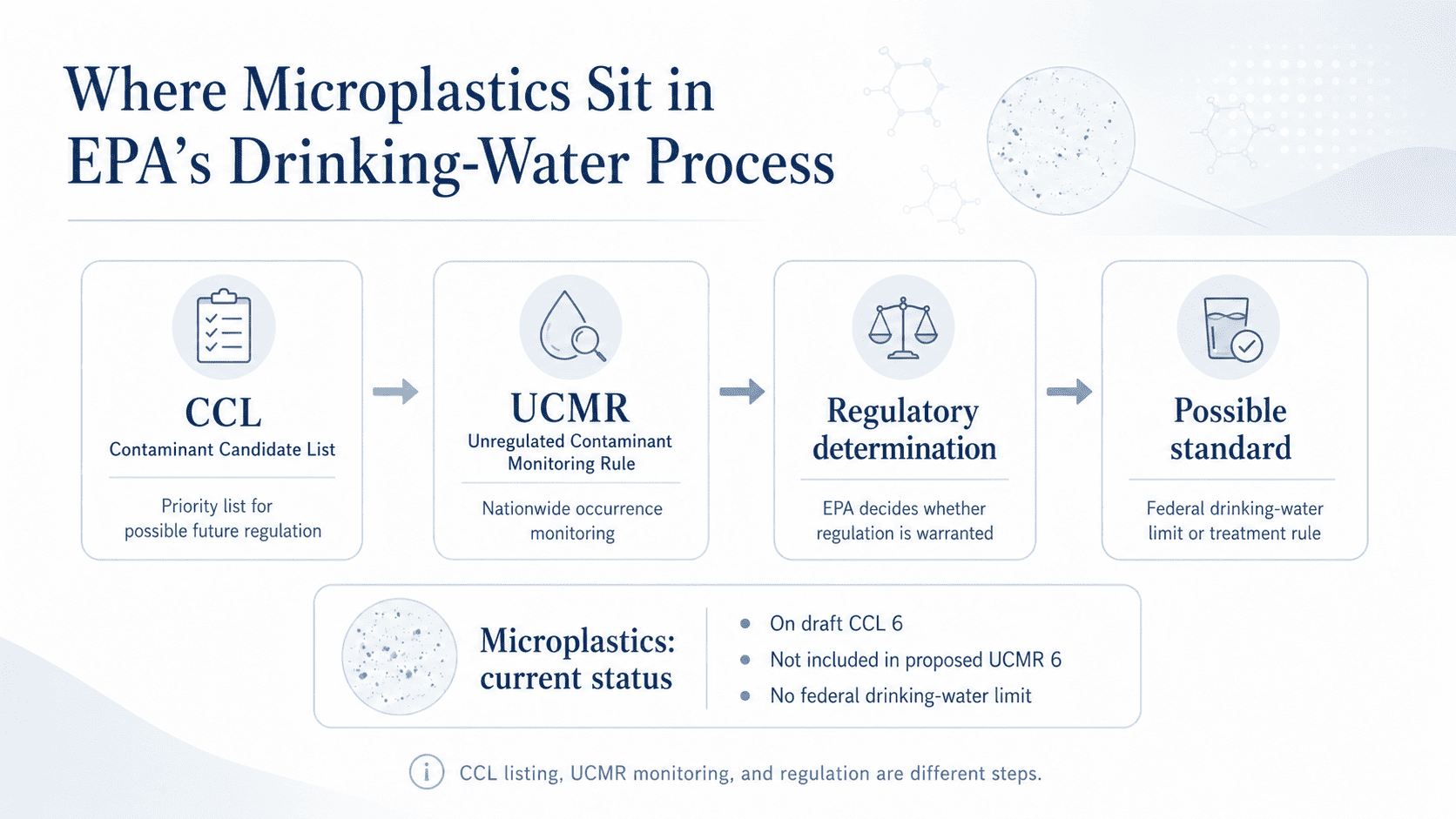
The Contaminant Candidate List, or CCL, is an early-stage priority list. EPA describes the CCL as a list of contaminants that are not currently subject to proposed or final national primary drinking-water regulations but are known or anticipated to occur in public water systems and may require future regulation. EPA’s draft CCL 6 includes microplastics as one of four contaminant groups, along with pharmaceuticals, PFAS, and disinfection byproducts (EPA, 2026a).
Being placed on the CCL does not mean a contaminant is now regulated. It also does not mean water systems must immediately monitor for it or remove it. The CCL is better understood as a formal way of saying: this contaminant may be important enough for EPA to evaluate further. For microplastics, that is a significant step because it places them inside the Safe Drinking Water Act evaluation pipeline. But it is not the same as a national testing requirement or a health-based limit.
The Unregulated Contaminant Monitoring Rule, or UCMR, is different. EPA uses UCMR to collect nationally comparable data for contaminants that may be present in drinking water and do not yet have health-based standards under the Safe Drinking Water Act. EPA’s proposed UCMR 6 would require monitoring for 30 chemical contaminants, with sample collection planned for 2028 through 2030 (EPA, 2026b).
UCMR monitoring can help EPA answer a practical occurrence question: how often does a contaminant appear in public water systems, and at what levels? Those data may later support a regulatory determination. But UCMR monitoring is still not regulation. If an unregulated contaminant is found during UCMR sampling, that does not automatically create a federal maximum contaminant level, treatment requirement, or violation.
A regulation is a later and more consequential step. EPA explains that, once it decides to regulate a drinking-water contaminant, it evaluates health-effects data and sets a maximum contaminant level goal–a non-enforceable health goal–before developing enforceable national primary drinking-water regulations, such as maximum contaminant levels or treatment-technique rules (EPA, 2026d).
| EPA status | What it means | What it does not mean |
| Draft CCL 6 listing | EPA has identified microplastics as a contaminant group that may require future drinking-water evaluation. | It does not require nationwide monitoring, treatment, consumer notification, or a health-based limit. |
| Not included in proposed UCMR 6 | EPA has not proposed nationwide microplastics monitoring for the 2028-2030 UCMR 6 cycle. | It does not mean EPA has concluded microplastics are safe. |
| No federal drinking-water regulation | There is currently no national EPA maximum contaminant level for microplastics in drinking water. | It does not mean microplastics are outside scientific or policy concern. |
This distinction helps explain why headlines can appear inconsistent. One headline may say EPA is moving toward action on microplastics because they are on the draft CCL 6. Another may say EPA has delayed drinking-water testing because they are absent from proposed UCMR 6. Both can be true if they are describing different points in the regulatory process.
For readers, the important point is that EPA’s April 2026 CCL action is a priority-setting step, while UCMR 6 would have been a nationwide occurrence-monitoring step. Regulation would require still more evidence and decision-making. Microplastics have moved further into EPA’s drinking-water process, but they have not yet reached the stages of national monitoring or enforceable regulation.
9. What consumers can reasonably do now
For consumers, microplastics create an awkward practical problem: the science is serious enough to pay attention to, but not settled enough to support precise personal-risk calculations. There is no federal drinking-water limit for microplastics, no routine nationwide public-water-system monitoring requirement, and no simple way for a household to know its exact microplastic exposure from water.
That does not mean consumers are powerless. It means personal choices should be framed as reasonable exposure-reduction steps, not as proven elimination of risk.
One practical step is to prefer safe tap water over routine bottled water when local tap water is reliable. Several studies have reported microplastics in bottled water, and some report higher particle counts in bottled water than in tap water, particularly when smaller particles or nanoplastics are included. Bottled water may also introduce particles from bottles, caps, storage, and handling. This does not mean bottled water is never appropriate. Bottled water may be necessary during emergencies, boil-water advisories, disasters, travel, or when tap water is known or suspected to be unsafe. But where municipal tap water is reliable, routine bottled-water use may not reduce microplastic exposure and may increase plastic waste.
A second step is to use filtration thoughtfully. Some household filters are certified to reduce microplastics under NSF/ANSI standards, and consumers should look for certification rather than relying on broad marketing claims. NSF states that filters certified to NSF/ANSI 401 can help reduce microplastics. Reverse osmosis systems and other membrane-based filters may also reduce microplastics, but performance depends on the product, membrane condition, particle-size range, installation, and maintenance. Claims about nanoplastics should be treated more cautiously unless the product has credible test data for that smaller size range. Certification matters because ‘removes microplastics’ is otherwise too vague: performance depends on particle size, filter design, maintenance, flow rate, and what the product was actually tested to reduce (NSF, n.d.; Cherian et al., 2023).
A third step is to maintain any filter according to the manufacturer’s instructions. A filter that is not replaced on schedule may perform poorly, become fouled, or provide a false sense of protection. This is a general principle of point-of-use treatment: a product’s performance depends not only on what it can remove under test conditions, but also on correct installation, flow, and maintenance.
A fourth step is to avoid treating bottled water as automatically cleaner. Bottled water may be useful in specific situations, but plastic packaging introduces its own exposure questions. If bottled water is used, it is reasonable to avoid storing plastic bottles in hot cars, direct sun, or other high-heat conditions. This recommendation is not a precise microplastics risk calculation; it is a general precaution that also aligns with broader concerns about plastic packaging and chemical migration.
A fifth step is to reduce avoidable plastic contact where convenient and affordable. Examples include using a stainless-steel or glass refillable bottle, avoiding unnecessary single-use plastic bottles, and not heating food or beverages in plastic containers unless the container is specifically designed for that use. These steps may not target drinking water alone, but they recognize that microplastic and plastic-chemical exposure is multi-route: water, food, dust, air, packaging, textiles, and household products all matter.
Consumers should be more cautious about dramatic claims. Boiling water, for example, has been studied as a possible way to reduce some nano- and microplastic particles under certain water-chemistry conditions, especially in harder water where mineral scale can trap particles. But boiling is not a general-purpose microplastics solution, and it should not be presented as equivalent to validated drinking-water treatment. The same caution applies to unverified countertop devices, detoxification products, and claims that a product eliminates all microplastics or nanoplastics without specifying test methods and particle-size ranges.
For people on private wells, the microplastics question sits alongside more established water-quality concerns. Private wells are not regulated like public water systems, and well owners are generally responsible for testing and maintenance. For most households, standard well concerns such as bacteria, nitrate, arsenic, lead, manganese, and local contaminants are more actionable than microplastics because they have established testing methods and health benchmarks. Microplastics may become more testable over time, but they should not displace basic well-water safety.
The measured conclusion is this: consumers can reasonably reduce reliance on plastic-bottled water, use certified and well-maintained filters if desired, avoid heating or storing water in plastic under harsh conditions, and reduce unnecessary single-use plastics. But no consumer action should be oversold as eliminating microplastics risk. At present, the strongest need remains better public monitoring, better methods, and better health-risk evidence.
10. What to watch next
The microplastics drinking-water story is likely to change over the next several years. The most important developments will not be single dramatic discoveries, but improvements in measurement, monitoring, toxicology, exposure assessment, and policy follow-through.
The first issue to watch is EPA’s final UCMR 6 decision. EPA proposed UCMR 6 without microplastics, but the final rule will show whether the agency maintains that position after public comment, petitions, and scientific input. If microplastics remain excluded, the United States will not get nationwide UCMR 6 occurrence data for microplastics during the 2028-2030 monitoring cycle. If EPA changes course, the key question will be what method, particle-size range, and reporting framework it requires (EPA, 2026b).
The second issue is what happens with draft CCL 6. Microplastics’ inclusion on the draft Contaminant Candidate List 6 is meaningful, but it is not a drinking-water standard. The important question is whether CCL listing leads to coordinated method development, occurrence studies, health-effects research, and eventually a regulatory determination. For microplastics, CCL status should be understood as entry into EPA’s drinking-water evaluation pipeline, not as evidence that regulation is imminent (EPA, 2026a).
The third issue is method validation. This may sound technical, but it is central. Without validated methods, national monitoring can produce confusing data rather than useful data. Researchers and regulators need agreement on what sizes to measure, how to avoid contamination, how to distinguish plastic from non-plastic particles, how to identify polymer type, and how to report results. A good monitoring system should not merely count particles; it should produce data that can be compared across laboratories, water systems, and time.
The fourth issue is whether state-level programs help clarify what federal monitoring could look like. California has been ahead of the federal government in developing microplastics drinking-water definitions, methods, and monitoring approaches. State-level experience may help show what kinds of sampling and reporting are feasible, what problems arise in practice, and how results can be communicated to the public without overstating health conclusions (California State Water Resources Control Board, n.d.).
The fifth issue is whether research can connect exposure to health outcomes more clearly. Detection in water and detection in human tissues are both important, but neither is the same as a dose-response relationship. The next stage of research needs to identify which particle types matter most, which exposure routes dominate, which populations may be more vulnerable, and which biological effects occur at plausible real-world exposures.
The sixth issue is how bottled-water and packaging research develops. If future studies continue to show higher particle counts in bottled water, especially when nanoplastics are included, consumers and regulators may pay more attention to bottle materials, caps, storage conditions, filling processes, and heat exposure. But interpretation will still require care: bottled-water findings can vary depending on brand, bottle type, storage, particle-size range, and analytical method.
Finally, watch for overconfident claims in both directions. It would be premature to say that microplastics in drinking water are harmless. It would also be premature to claim that current drinking-water exposure has been proven to cause specific diseases. The scientifically responsible middle position is that microplastics are a legitimate emerging drinking-water concern, but one that still needs better methods and stronger health-risk evidence before the public can interpret results with confidence.
Summary
Microplastics in drinking water are real, but the public conversation often runs ahead of the science. The most responsible interpretation is neither complacency nor alarm. Microplastics and nanoplastics are plausible contaminants of concern; they have been detected in drinking water and in human biological samples; and they deserve better monitoring and health-risk research. At the same time, current evidence does not yet allow confident claims about disease risk from drinking water alone.
EPA’s current position reflects that unresolved state of the evidence. Microplastics have moved onto the draft CCL 6 priority list, but they have not been included in proposed UCMR 6 nationwide monitoring, and there is no federal drinking-water limit. The next meaningful advances will depend on validated methods, comparable data, and health studies that can distinguish detection from risk.
AI Use Policy
h2oIQ may use AI tools to assist with outlining, drafting, summarizing, comparison, and editorial review. AI-assisted material is subject to human editorial direction, independent source checking, and revision before publication.
AI is not treated as an authority. Scientific claims should be traceable to primary literature, government agencies, public-health organizations, or other credible sources.
References
California State Water Resources Control Board. (n.d.). Microplastics drinking water. Retrieved July 4, 2026, from https://www.waterboards.ca.gov/drinking_water/certlic/drinkingwater/microplastics.html
Cherian, A. G., Liu, Z., McKie, M. J., Almuhtaram, H., & Andrews, R. C. (2023). Microplastic removal from drinking water using point-of-use treatment devices. Polymers, 15(6), 1331. https://doi.org/10.3390/polym15061331
Gambino, I., Bagordo, F., Grassi, T., Panico, A., & De Donno, A. (2022). Occurrence of microplastics in tap and bottled water: Current knowledge. International Journal of Environmental Research and Public Health, 19(9), 5283. https://doi.org/10.3390/ijerph19095283
Marfella, R., Prattichizzo, F., Sardu, C., et al. (2024). Microplastics and nanoplastics in atheromas and cardiovascular events. The New England Journal of Medicine, 390, 900-910. https://doi.org/10.1056/NEJMoa2309822
NSF. (n.d.). Water filters FAQs. Retrieved July 4, 2026, from https://www.nsf.org/about-nsf/faqs/water-filters-faqs
Qian, N., Gao, X., Lang, X., Deng, H., Bratu, T. M., Chen, Q., Stapleton, P., Yan, B., & Min, W. (2024). Rapid single-particle chemical imaging of nanoplastics by SRS microscopy. Proceedings of the National Academy of Sciences, 121(3), e2300582121. https://doi.org/10.1073/pnas.2300582121
Roslan, N. S., Lee, Y. Y., Ibrahim, Y. S., Tuan Anuar, S., Lee, Y. H., & Karuppannan, S. K. (2024). Detection of microplastics in human tissues and organs: A scoping review. Journal of Global Health, 14, 04179. https://doi.org/10.7189/jogh.14.04179
U.S. Environmental Protection Agency. (2026a). Draft Contaminant Candidate List 6 – CCL 6. Retrieved July 4, 2026, from https://www.epa.gov/ccl/draft-contaminant-candidate-list-6-ccl-6
U.S. Environmental Protection Agency. (2026b, July 1). Revisions to establish the Sixth Unregulated Contaminant Monitoring Rule (UCMR 6) for public water systems. Federal Register. https://www.federalregister.gov/documents/2026/07/01/2026-13263/revisions-to-establish-the-sixth-unregulated-contaminant-monitoring-rule-ucmr-6-for-public-water
U.S. Environmental Protection Agency. (2026c). Microplastics research. Retrieved July 4, 2026, from https://www.epa.gov/water-research/microplastics-research
U.S. Environmental Protection Agency. (2026d). How EPA regulates drinking water contaminants. Retrieved July 4, 2026, from https://www.epa.gov/sdwa/how-epa-regulates-drinking-water-contaminants
World Health Organization. (2019). Microplastics in drinking-water. https://www.who.int/publications/i/item/9789241516198
Yang, L., et al. (2024). Microplastics in drinking water: A review on methods, occurrence, health risks, and research needs. Environmental Pollution. https://doi.org/10.1016/j.envpol.2024.124571